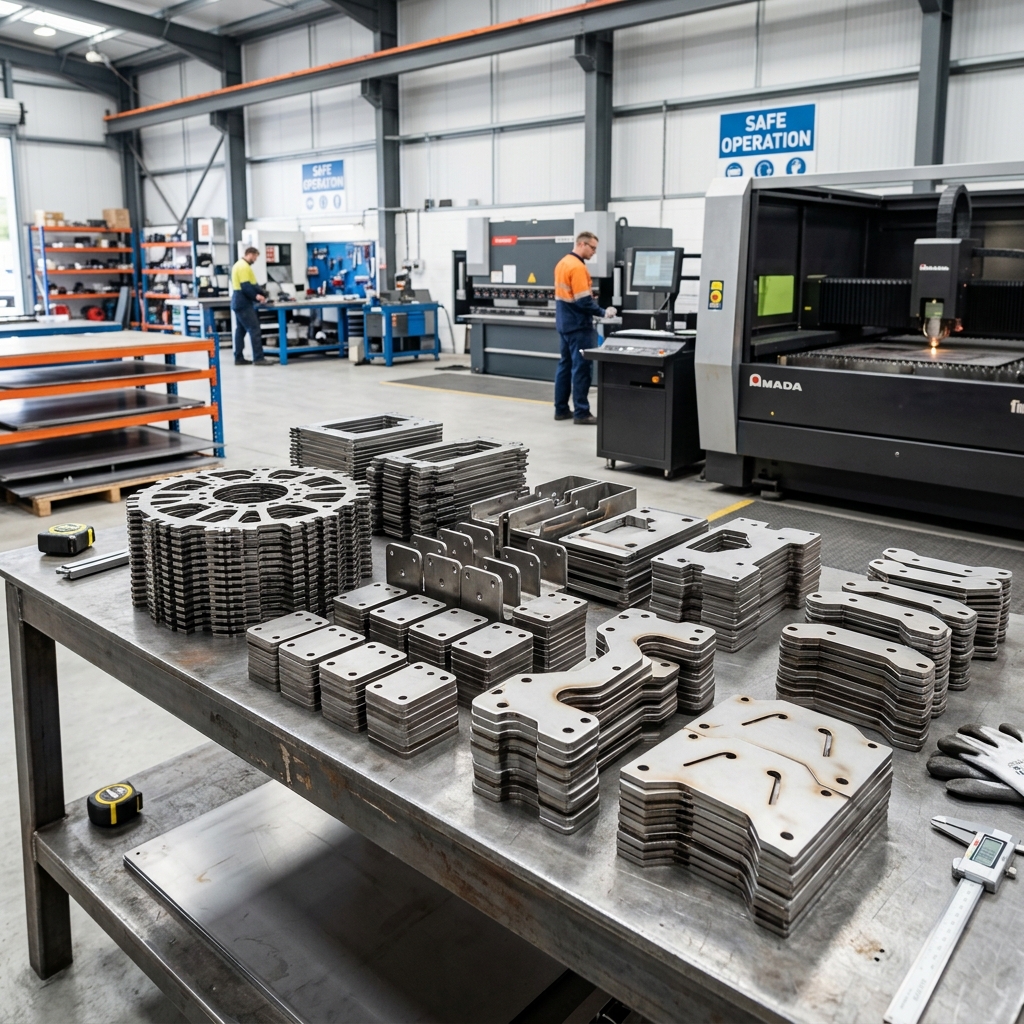
When companies buy a laser cutting machine, they often focus on machine price. But the more important number is cost per part.
What Is Cost Per Part?
Cost per part is the total production cost divided by the number of parts produced. In simple terms: total cutting cost divided by number of parts produced equals cost per part.
This includes machine time, electricity, gas, consumables, labour, maintenance, and overheads.
Why Cost Per Part Matters
Cost per part helps you understand real production cost, profit margin, quotation accuracy, machine efficiency, ROI, competitiveness, and outsourcing versus in-house production decisions.
1. Cutting Speed
Faster cutting means more parts per hour. Cutting speed depends on laser power, material type, thickness, gas, machine quality, parameters, and operator skill.
2. Material Thickness
Thicker material usually requires slower cutting speed and more power, increasing machine time, gas, and electricity cost.
3. Assist Gas Usage
Oxygen, nitrogen, and air have different costs and finish results. Gas cost can strongly affect high-volume production.
4. Electricity Consumption
The source, chiller, compressor, exhaust, and machine movement consume power and should be included in costing.
5. Consumables
Protective lenses, cutting nozzles, ceramic rings, focus lenses, collimation lenses, and other accessories affect quality, rejection, and downtime.
6. Labour Cost
Operators, supervisors, loading support, and maintenance staff affect cost per part. Higher productivity can reduce labour cost per component.
7. Machine Downtime
Downtime from consumable failure, poor maintenance, wrong settings, breakdowns, missing parts, or operator error is a hidden cost.
8. Rejection and Rework
Poor cutting quality creates rework and rejected parts. Correct selection, parameters, and consumables reduce this cost.
How to Reduce Cost Per Part
Choose the right laser power, use correct cutting parameters, maintain the machine, use quality consumables, reduce downtime, improve nesting, train operators, use automation where required, and track actual production cost regularly.
Conclusion
Cost per part helps you understand whether your laser cutting machine is truly profitable.
Call to Action
Want to understand which laser cutting machine suits your production cost target? Speak to Adhikhah with your material, thickness, volume, and current cutting process.